
return to the solar harvest article or insolation subsection
PVWatts
You can use PVWatts to find solar harvest estimates for a particular place, month, array size, etc. You can use this info to
- find out how much panel is required to make a certain amount of Watt-hours (Wh) daily; or
- find out how much power your existing solar setup can make
how much panel do I need to make X watt-hours?
GET STARTED
First, pick a location using the search bar:

SOLAR RESOURCE DATA
This page shows you the location it selected. Accept the default unless it needs correcting.
SYSTEM INFO
Change TILT to 0, and accept the other defaults on this page. The other settings won't make a difference for what we want (Hours of F**ull **S**un **Equivalent (FSE), which will be given on the next page).
RESULTS
The results has three columns: month, solar radiation (aka FSE), and AC Energy. We want that middle column. We will use the lowest FSE for any month we will be camping. For fulltimers this will usually be December.
using the results
Run the arithmetic below, using 0.85 for overall system efficiency with MPPT and 0.7 with PWM.
Wh required / "Solar Radiation" (FSE) / overall system efficiency
example
[[https://img.mousetrap.net/misc/thumbs/stuttgartFSE.jpg (external image)]]

You need 900Wh/day. You live in Stuttgart, Germany and the lowest FSE in a month you will be camping is 2.37 October. You have an MPPT solar charge controller.
So 900Wh / 2.37 / 0.85 = 446.76w of flat-mounted panel. Round up to 450w or 500w, whatever is available.
how much energy can my system harvest?
GET STARTED
First, pick a location using the search bar:
SOLAR RESOURCE DATA
This page shows you the location it selected. Accept the default unless it needs correcting.
SYSTEM INFO
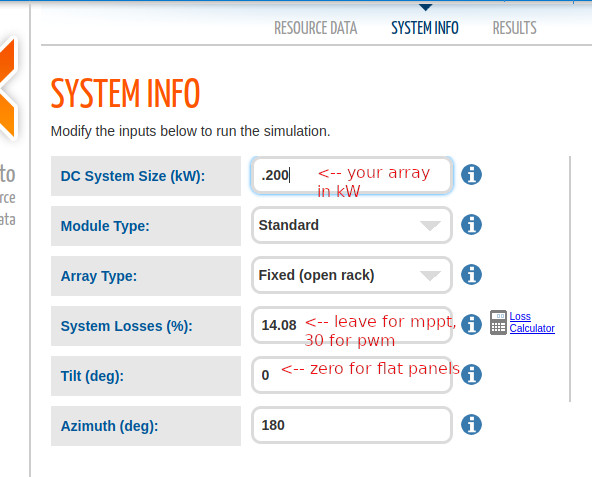
We need to make a couple changes to the defaults here:
- your array size in kW**. A kilowatt is 1,000w, so a 200w = 0**.2kW (zero-point-two)[1]
- accept the default losses for MPPT systems. PWM systems should use something like 30%((PWM doesn't really have 30% losses in the system; on average it leaves ~30% unharvested. The end result is the same, math-wise))
- if your panels are flat (most are) adjust tilt to zero
RESULTS
The second column is kWh/square meter/day, AKA Hours of Full Sun Equivalent (FSE).
The third column is kWh harvested per month. To find average harvest per day divide this figure by the number of days in that month.
Example: In January in this location the system could make 17kWh. 17 divided by 31 days = 0.548kWh/day, (548Wh/day).
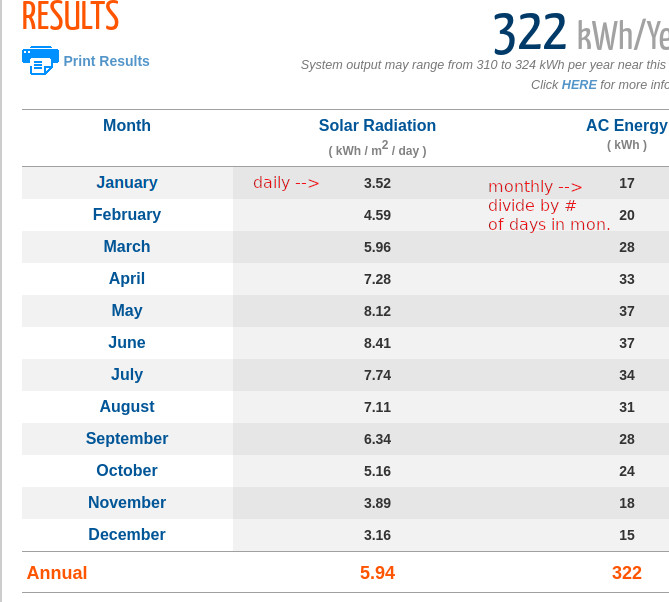
Note: the 3rd column is rounded to whole numbers. This makes little difference with large residential installs but can distort the result with our small systems. You can use the FSE number to do the math for your setup more accurately:
FSE x array wattage x ((100 - system losses) / 100)
...which gives a more precise 605Wh/day. You may want to plug that formula into a spreadsheet for easy re-use. The system losses will be 14.08 or 30.0 as above, depending on the controller.