
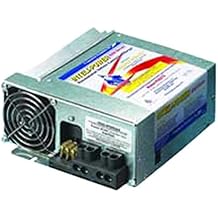
(external image) A converter (a.k.a. converter/charger) handles power and charging needs when connected to shore power:
- charge the house battery
- provide 12v to power house loads
For turning 12v into 110v see inverters.
Providing 12v
OEM converters generally do a good job of providing 12v to the house. They can do this even if the battery is absent or dead. All the RVer has to check is if the converter Amperage rating is sufficient for present needs.
Charging the house battery
OEM converters are notoriously cheap and dumb (single-stage), lacking smart charging functions.
Note: if you have sufficient solar to complete Absorption then a "dumb" converter can work fine and shore power will support the battery on subsequent days. In this model the converter + solar would contribute up to Vfloat, then solar would raise the bank to Vabs and fall back to Vfloat when Absorption is done. Shore power holds Vfloat indefinitely thereafter.
Some single-stage converters allow the user to configure the float voltage, typically somewhere between 13.2v - 13.8v. If the converter does not allow this adjustment then pick one with an appropriate float voltage (Vfloat) for your battery bank.
Choosing a converter
If money is no object you can buy a multistage ("smart") converter rated at the bank's maximum current acceptance at the lowest normal state of charge:
- 0.33C for AGM at 50% SoC
- 0.2C for FLA at 50% SoC
- 0.4C is not LiFePO4's max at 20% SoC, but is probably a max rate for good cycle life. 0.2C would be optimal if one has the time.
The higher the rating and the more features the more expensive the shore power charger. There is also a practical limit on what we can pull from a 15A shore power connection for hours/days.
Limits of 15A shore power
13A off a 15A shore power plug, or 1,560w is a safe limit for continuous power use. Assuming 10% conversion losses this would give us a theoretical max of around 100A of converter charging (14.4Vabs x 100A).[1]
Minimum charge rate
Lead chemistries require a minimum charge rate to stay healthy. In the absence of documentation from your battery mfg we can assume
- 0.2C for AGM
- 0.1C for Flooded Lead Acid
- [LiFePO4 has no minimum current spec]
Charging time available
If you have solar and will be on shore power for more than one day then a simple converter that charges at the batteries' recommended Float voltage is fine; solar will be able to do the relatively light duty of completing Absorption each day.
If you do not have solar or will be on shore power for only one overnight then we need a three-stage ("smart") converter that can handle Absorption duties.
Aftermarket converters
Aftermarket converters tend to be higher quality than OEM, but some are still "dumb" single-stage chargers. Higher-end aftermarket converters often have multistage charging built in, or available as an upgrade. (See the PD w/Charge Wizard below)
Three converter makers are generally respected on the CRVL forum. In alphabetical order:
- Iota
- Powermax
- Progressive dynamics with Charge Wizard built in or added. Note: the PD may be better suited for shore power sources rather than generator charging.
Although WFCO converter upgrades are most often seen on youtube, the videos might best be used for install walkthroughs rather than product choice.
SternWake says he leans toward Progressive Dynamics "for the ability to choose stages, holding 14.4 for 4 hours at the press of a button"[2]
shore power chargers
(external image) When bulk charging is handled by other means a small (10-20A) smart charger/maintainer may be sufficient. They are generally not intended to be permanently mounted in the vehicle so mounting may have to be fabricated, or storage found for it when not in use.

DIY "converters"
DIY dumb converters
"Dumb" converters output a single voltage and work fine when solar charging is present (see above) or when the bank is lithium chemistry. In this scenario the 12v power supply can is set to ~13.x voltages to provide "low float" support while on shore power.
If loads are run off the converter in the daytime the converter will just be supporting the solar yield and can be rather small. If used at night the converter will be carrying the whole burden should be sized to your expected loads (20A, 40A, whatever).
DIY smart converters
It is possible to build a DIY converter from a power supply and MPPT charge controller.
Benefits include:
- lower cost than a comparable commercial product
- greater configurability
- secondary use of charge controller as a spare if needed
Further reading:
- an EE chimes in
- Owner of Midnite Solar chimes in